Cognitive Behavioral Therapy: Master Your Brain, Depression And Anxiety (Anxiety, Happiness, Cognitive Therapy, Psychology, Depression, Cognitive Psychology, CBT) by George Muntau
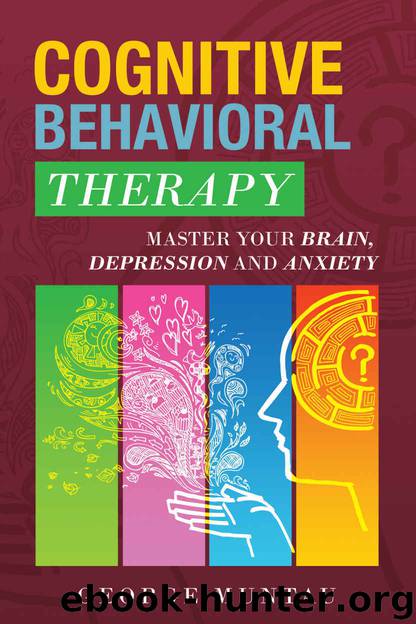
Author:George Muntau [Muntau, George]
Language: eng
Format: azw3
Published: 2017-10-15T04:00:00+00:00
CBT for Intrusive OCD Thoughts
Cognitive behavioral therapy points out that OCD or Obsessive Compulsive Disorder is when people misread intrusive thoughts or compelling urges as indications that harm will occur and they are directly responsible for their actions.
When it comes to treating OCD or intrusive thoughts through CBT, it helps individuals understand that their intrusive or disturbing obsessive thoughts are nothing but a result of anxiety than any real danger. OCD patients are gradually made to realize that they won’t be affected or in danger if they don’t give in to these thoughts.
People with OCD are desperately trying to avoid harm. Their solutions invariably end up becoming part of the issue. For instance, if you keep thinking about neutralizing your thoughts about stabbing someone, it only ends up increasing these intrusive thoughts.
The real issues, therefore, aren’t these intrusive thoughts but the meaning assigned to them by an individual suffering from OCD. For example, you may experience a huge urge to act upon your intrusive thoughts or that you shouldn’t have these thoughts in the first place. This places a huge level of threat, anxiety, and responsibility on you. In the above example, you’ll stop meeting the person alone or stop stocking your kitchen with knives. You’ve succumbed to the fear. The fear is still alive, and further stops you from thinking that your fear is nothing but a skewed thought.
One of the most important aspects of using CBT to treat OCD or intrusive thoughts is that the therapist only functions as a facilitator and that it has to be practiced on your own.
Different therapists focus on different cognitive and behavioral attributes of OCD or intrusive thoughts. A cognitive focused approach will help you assess your thought patterns more keenly. For instance, you have thoughts about killing someone, which makes you feel that are a bad person for having these thoughts and you could act upon them. Your therapist will work with you to seek a different understanding of these distorted thoughts and give you an alternate technique for reacting to them.
If it’s a more behavioral focused approach, it could be focused on educating yourself about how anxiety is felt by the body. It is about facing your fears and gradually taking on, and increasing the very activities you fear. For instance, if you suffer from social anxiety, your therapist will slowly get you to come out of your shell and participate in interactions on a smaller scale.
Where OCD or intrusive thoughts are concerned, the end goal of CBT is to change the brain’s thought process or structure. Even if this sounds like a Herculean task, it isn’t. Let’s consider an example.
Let’s assume you have lived in the United States of America all your life, and are used to a right-hand drive. There was no hassle of changing gears. Suddenly, you have to move to the United Kingdom, which is a left-hand drive. How will you manage?
To learn to drive left-handed, you have to unlearn right-handed driving. What makes the entire pursuit tough is that it has become a subconscious or almost involuntary process.
Download
This site does not store any files on its server. We only index and link to content provided by other sites. Please contact the content providers to delete copyright contents if any and email us, we'll remove relevant links or contents immediately.
| Administration & Medicine Economics | Allied Health Professions |
| Basic Sciences | Dentistry |
| History | Medical Informatics |
| Medicine | Nursing |
| Pharmacology | Psychology |
| Research | Veterinary Medicine |
The Art of Thinking Clearly by Rolf Dobelli(10650)
The 5 Love Languages: The Secret to Love That Lasts by Gary Chapman(9950)
Mindhunter: Inside the FBI's Elite Serial Crime Unit by John E. Douglas & Mark Olshaker(9456)
Becoming Supernatural by Dr. Joe Dispenza(8314)
Nudge - Improving Decisions about Health, Wealth, and Happiness by Thaler Sunstein(7793)
The Road Less Traveled by M. Scott Peck(7694)
Mastermind: How to Think Like Sherlock Holmes by Maria Konnikova(7472)
Enlightenment Now: The Case for Reason, Science, Humanism, and Progress by Steven Pinker(7379)
Win Bigly by Scott Adams(7295)
The Way of Zen by Alan W. Watts(6698)
Factfulness: Ten Reasons We're Wrong About the World – and Why Things Are Better Than You Think by Hans Rosling(4814)
The State of Affairs by Esther Perel(4791)
Gerald's Game by Stephen King(4742)
Man's Search for Meaning by Viktor Frankl(4687)
The Confidence Code by Katty Kay(4331)
Thinking in Bets by Annie Duke(4309)
The Healing Self by Deepak Chopra(3681)
Hidden Persuasion: 33 psychological influence techniques in advertising by Marc Andrews & Matthijs van Leeuwen & Rick van Baaren(3612)
The Worm at the Core by Sheldon Solomon(3537)
